Featured Post

The End (of the Beginning)

For my blog this may be the end, but as for me, it is not the end, it is not even the beginning of the end. It is simply the end of the begi...

Showing posts with label Chemistry. Show all posts

Sunday, September 17, 2017

It's Not Yet Time

"Sometimes It's Not Goodbye, Just A Hello Waiting Patiently for Another Time"

~The Better Man Project


I stumbled across "professional life coach, writer, and diehard encourager" Evan Sanders's blog, and I was immediately struck by how raw and genuine his writing is. A particular post, And I Wondered, "Does This Path Have Heart," grabbed me. I read it a few times realizing that I connected with it because I so deeply relate to what he writes, so much so that I could have written it myself. 

He talks about his challenge never having been to successfully love deeply, but it being in the letting go. He writes about how scenes and moments play over and over in his mind in full color and how each instance he feels all those emotions so deeply. 

This isn't another rant why breakups hurt so much (even though they do and I was thinking today about more reasons why breakups are so hard...perhaps I'll share them before this post is over), and if you're looking for practical ways to get over a breakup and/or unrequited love, I direct you to my Loves Me Not post and suggest you track down a copy of the book that inspired the post. I'm not quite sure what this post is about yet, to be honest, but as I'm writing I think it's about timing.

A client of mine this week shared that he was finally in the place career-wise that he was trying to get to for the past five years or so, a place that would have made his previous relationship of four years work that much easier. They're no longer together, and his current relationship doesn't feel the same to him. He just wants to share this success and happiness with someone he feels like cares about it as much as he does, someone who saw him through the hard work and knows what it means to him.

This is one of those reasons (that I mentioned I might write about) why breakups hurt. It's in the sharing your life with someone who genuinely cares about you. Your happiness makes them happy and vice versa. It's just how relationships work; it's in the connectedness. When you lose/don't have this person everything seems so much less vibrant or exciting. Truly, having someone to share your life with halves your troubles and doubles your joys.

Back to the timing thing though. If only my client could have gotten to where he is now a year and a half ago. Maybe it would have saved his relationship. And maybe his relationship just wasn't meant to be. And for the breakups and goodbyes that I'm struggling with now, clearly we're not meant to be right now. It's not yet time.

I need the space, we need the space, to get to where we can have a real chance. Love/like/affection/comfortability does NOT conquer all. I'm learning that everything has a time and place, and as much as patience is not something I'm great at, I'm strengthening it every day. Together with my emunah.

Monday, July 24, 2017

Single Come, Single Go: Singles Events and Speed-Dating

"The reason I wouldn't have 'said yes' to date him is the reason it ultimately didn't work out," a friend related to me, describing her experience in dating a guy she first met at a speed-dating event.

Conversely, "The only people I've ever dated more than one or two dates were people I met organically, like at a singles' event," another friend disclosed.

How helpful are these type of events? Is this useful hishtadlus, or is it a waste of time?

I personally like meeting new people, so even if events such as these aren't all that helpful, they can be fun, if not, ultimately, frustrating. Yet, they may be anxiety-producing for others, and so I understand why such people would likely steer clear of them if these events have little to no success rate. (If that's the case...I actually don't know.)

There is an art to organizing a productive singles event. Just putting a bunch of guys and girls in a room or even something semi more organized than that, isn't likely to work very well. I believe if there is decent vetting going on, like let's say at least 10 out of 15 guys there would have been otherwise suggested for me, it could actually work. At the very least I can spend 3 hours, versus 30, to decide if these guys are even ballpark at all. Basically, there needs to be handpicked participants who are similar in many ways.

However, this still may be a fail, because the small amount of time one gets to spend talking to someone at such an event is little more than a embellished photo or video clip of the person. Is it enough time to really give someone a decent shot? I know that some of the guys I've dated longest I probably wouldn't have dated had I met them first for only five minutes. On the other hand, I didn't end up marrying them.

Such events are great for networking and meeting a lot of people at once, yet are we going off of anything more than looks (or better case chein/charisma)? Is it mostly about who makes good first impressions?

Our shidduch system has a lot of flaws, and a big one lies in the fact that singles generally rely on others (shadchanim, friends, whoever) to set them up. Singles events can help remedy this, but in more cases than not when someone sets a couple up, hopefully, there are perceived underlying commonalities and/or reasons. This is missing when people meet at an event like this. Attraction, chemistry, and all that good stuff is left out though in the former situation, because there isn't a way for a third party to know how that might work between the two parties. Meeting organically though starts at the place of attraction or at least superficial interest or "click."

I recently met a guy at a singles' event that strategically I shouldn't have been at; I doubt anybody would have suggested the idea within the shidduch realm. We hit it off right away though, and it'd been awhile since I'd connected like that, or felt comfortable, with someone that quickly (or maybe ever –– the comfortable that quickly part). Long story short, connection and comfort isn't the only thing that matters in a relationship, especially when it's about marriage potential. Someone can be an awesome person, and the chemistry can be great, but it doesn't mean it makes sense marriage-wise.

Shidduch "investigations" on either side would have prevented us from dating probably had the idea come about a different way. Obviously we were meant to meet each other and I have no regrets (in fact I gained a lot from the experience), but this is a good example of why third-party suggesting makes sense.

How successful are singles events really?

Friday, July 21, 2017

Solving for "S"

Following the end of a relationship, something perhaps too short to rationally actually warrant to be called a breakup, but a "breakup" all the same (in tribute to the feeling of click/connection), I just feel sad.

It's never helpful to place judgement on feelings, because they're never right or wrong, they're just feelings. (It's the whole feelings are messages thing. When you try to fight them they find a way to sneak back in where you least expect them. When you honor their message, they dissipate.)

The message of sadness is one of loss. Sure, I lost the relationship, its potential, the person in my life (and everything he brought to the table), the connection we had...but because I'm great at analyzing things, I'm thinking it's not just that. (Rationally it seems like it was too short to feel real loss of any or all of those things!)

I'm still figuring it out, but so far I've been able to pinpoint that perhaps this is about how connection causes a surge of feel good chemicals in one's brain. With the loss of the relationship/connection, my brain is aching for that dopamine, oxytocin, serotonin, and endorphins that came along with the interaction.

Gotta get to work replenishing that balance... Social interaction, ie. hanging out with friends, exercise (maybe I need to double the workout routine), sunlight, chocolate/ice cream, and physical touch (lots of hugs and/or a massage) will all help with that.

Tuesday, June 13, 2017

Scoring on a Rebound

Can a rebound be the real deal?

Seeking comfort after a heartbreaking, perhaps severely distressing, experience in which you may be questioning yourself, your self-worth, your desirability, etc., is completely normal. These feelings of vulnerability and loneliness can be staunched by connecting with someone new, even if this person isn't right for you. In situations where emotions are heightened, it is common for people to confuse their feelings for something different. (For more of a discussion about this, refer to my "Love At First Sight" post.)

What goes through people's heads' who date someone seriously, perhaps for long drawn out periods of time, dump her/him, and then get engaged to the next suitor, a mere few weeks later? Is this pure rebound science? Are people in these relationships happily married?

Science suggests that rebound relationships can definitely help people heal from a breakup, because being in a relationship (presumably any relationship) promotes higher self-esteem, attachment security, and all those good things that come from healthy relationships. However, when someone is clinging to a relationship only because s/he wants to feel wanted and the relationship is all wrong, this backfires. Therefore, when people marry a rebound, often the foundation of the relationship is critically damaged. It's the same kind of situation that results from someone trying to fill a need in himself/herself by marrying someone that has that specific characteristic. For example, if John himself wants to be (or wants to be seen as) more confident and/or assertive, he may be looking to marry someone who is all that.

However, your spouse is not your cure-all. Two complete people are needed in a relationship for that relationship to work (in a healthy manner). You cannot marry someone just because s/he fills a need. I mean, you can, but that relationship is going to have holes in it, and it's going to take a lot of work to make that healthy and fulfilling in the long run.
If you weren’t willing to settle for your ex, you’re a fool to settle for your rebound.I'm no stranger to this phenomenon of rebound relationships...at least being the party from whom the rebounder is rebounding...Recently, a friend of mine had the same situation. The guy she dated seriously, who said he likes to take things slow and work relationships out slooowly, got engaged a very short time after they broke up.

The only thing I can think of is that something that didn't click with the last relationship, clicked with the new one. What didn't feel right after months of dating, obviously felt right with the kallah.

I have a friend who married her rebound, and she's happily married. When she was dating her husband, it was "so clear" to me that it was a rebound, but somehow it worked out for her, and she really just believes the right one came on the heals of the very wrong one. It could happen.

Friday, June 9, 2017

Dating Like A Boss

You know how they say that confidence is one of the most attractive traits? Perhaps there is a median here. Sure, confidence lends people poise, charm, assertiveness, and those, by definition, draw people to someone. It's also about if you are self-assured and you like yourself, it's easy for others to like you. However, arrogance and cockiness is not attractive in the least bit.

Having confidence about something that is not true, like when someone thinks s/he's smart, attractive, with-it, etc. and s/he is not, that is the quintessential turn-off. Also, many arrogant people operate from a place of ego. Under their mask, they aren't really confident, so they work hard to make up for it.

Not everyone finds confidence so attractive though. Many people are intimidated by it. Either they question what the confident person sees in them, because that confident person seems to have it all together, or they wonder if they will ever be able to measure up. 

There is an added element with dating. Confident singles are direct, smile, make eye contact and speak with warmth and interest. They make it obvious that they’re interested, and so it's easy to like them because you know where you stand with them. 

Interestingly, in a study done at Webster University, the researchers found that the girls who got more attention at the bar they were camping out in were the ones that made eye contact and were direct, versus the ones who were shy and barely talked. It didn't matter what they looked like!

Please just keep in mind that condescending arrogance is not confidence...

Thursday, December 15, 2016

The "Hard to Get" Seesaw

Dr. David Lieberman, the human behavior and relationships guru, in the same dating/relationships talk in which he spoke about mental health issues and red flags, discussed the delicate balance of give and take in an early relationship. He spoke about how there needs to be some sense of holding back, "playing hard to get" if you will. Pop psychology explains that this increases your mystique, attraction and desirability level. Being needy and clingy, over-interested, is unattractive, and if the other person thinks that you worship him/her then s/he may start thinking that s/he can do better.

On the other hand, if you're distant and aloof, the other person may begin to believe that you don't like him/her, that you aren't into the shidduch, so s/he will begin to develop a distance and think about all the reasons why s/he doesn't think it will work. Some of that is probably resentment, and part of that is him/her protecting himself/herself. Being straightforward with someone develops trust and honesty in the relationship, and it contributes to someone's feelings for the other.

"Playing hard to get" may increase desire (to pursue someone), but it decreases positive feelings towards the person. There is a delicate balance here that needs to be achieved. If you like someone, you don't need to show everything, but let him/her know that you're interested in him/her, committed to seeing things through.

Wednesday, December 7, 2016

Levels of Attraction

What's behind attraction? Is it simply just "click," or are there other things at play?

I truly believe that everyone connects differently with their significant other, and the deal gets sealed with different aspects in mind for each person. Some people come from an emotional place -- they have feelings for the person, and they feel like they connect on a deeper level. Others see it intellectually -- details of a shidduch make sense to them rationally.

If we're going with the attraction (rather than as an intellectual choice) version, on the reptilian brain level, our survival mechanism, our animalistic function, we pay attention to externals. We assess looks, health, status, etc. A guy once told me that as per a Seinfeld episode, he thinks lustrious hair and rosy cheeks are important (I can't remember the rest of that list), but those are both indicators of one's health. This part is usually subconscious, unless someone places a lot of significance on externals...keeping in mind that I do think that external reflects internal (if you like who someone is as a person, you will likely find their physical appearance attractive).

On that note, our mammalian/limbic brain appraises emotional attraction. Is there trust, comfort in the relationship? Does the person match your emotional intelligence level? have a uniqueness, a je ne sais quio, that "one thing"? Is there a sense of excitement? Do you enjoy the person's company? Perhaps intelligence is really crucial for someone. "Sapiophiles" are people who are attracted to intelligence.

Then comes the logic. (Not in this particular order necessarily!) Do you have shared goals, values? Does the person treat you right? Do you like who you are in the person's company? Can you grow together?

If we use "love" as it's used in the vernacular, its stages usually go from lust/excitement, to romantic attraction/passion, to attachment/commitment, as we peel away the layers of who someone is and why we're attracted to him/her.

Tuesday, December 6, 2016

9.5 on the Richter Scale

There are many different "systems" that people use to assess the potential of a relationship and/or the attractivity or "click" with their date. Some people swear by their method, while others just sort of play it by ear and base their dating on how they feel as they go along, or what boxes they can check off.

One person told me that his way is to give each of his dates a number on a scale of 1-5. "Ones" are basically the one-and-dones, the people that there is no merit in seeing it past date one. A "Five" would be someone who this person fell for shortly after meeting and would marry in a heartbeat. The way the person explained it is that the number someone might be assigned after a first date usually doesn't change, but sometimes it does. "Twos" usually get a second or third date, and "Threes" generally get about three dates. A "Four" is someone who might actually be marriage material along with a "Five."

Another person outlined his theory in that he thinks that each person has a certain shidduch value and that everyone will end up marrying someone within a 5-10 point range of their own number (out of 100). People get points for different things, and obviously each person assigns their points differently. While I might think that someone gets 30 points (as an example) for being a learning guy, someone else would subtract 40 points for the fact that he's learning and not working. Everyone also spends their points differently. So, if someone uses a good portion of his/her points on looks, he may have to compromise on smarts or middos.

There's the common "Three Strikes and You're Out" method too. Although, generally people are more generous with their outs allotment. Perhaps there are certain semi deal breakers that presented separately may not be a large issue, but taken all together are too much for the person to handle.

Honestly, all these techniques seem sort of rigid and demeaning to me, especially when people get assigned a value. I get it that some people need things to be concrete, but I like to go with the good ole "Does this feel right? Do we have the same values? Do I enjoy spending time with this person? Does he treat me right? Do I like who I am with him?"

Why must we over-intellectualize everything?

Wednesday, November 30, 2016

The Platonic Relationship

The million dollar question: Can a guy and a girl "just be friends?"

Is it possible for two people who dated seriously to, following their breakup, foster a platonic relationship?

Theoretically, it should be possible. If they didn't cross any lines while they were dating, didn't share anything together that two good friends wouldn't, it's not like they have to figure out how to relate to each other differently, because they've been doing that on a non-physical level up until this point.

Does the simple fact that the person who "set them up" thought they would make a good couple have to dictate the relationship they must have? The reality that they dated for however long and then broke up sort of shows that their relationship falls in a different category. This is especially true if they broke up because they didn't have shared values (one of the top three on the list of factors of marital success and happiness). Best friends don't need to have all the same values, as they can still have a great friendship even if they don't agree on some core beliefs, particularly if they understand each other and communicate well.

With all that said, truthfully, it's probably not that possible for a guy and a girl to be good friends, lean on each other emotionally and stay within platonic parameters. Even if a couple has the ultimate respect for one another and never cross any lines, the way that man (and woman) was created, there's a basic attraction that complicates things. The fact that at least one of them, if not both, will have to set boundaries, adjust feelings, and pretend that s/he is happy the way things are, means that the relationship cannot be platonic.

Things may be a little different on the girl's end, but unless he's truly not attracted to her, perhaps she's really unattractive or he's gay, this usually does not work. (If the girl is attracted to him even if he's not attracted to her this doesn't work either. It's just more likely for a girl not to see guy like that because girls are less physical.) And, when a girl leans on someone emotionally, she starts to see him differently even if she wasn't previously attracted to him.

Real platonic relationships are extremely rare. You can, however, pretend your relationship is platonic, and sometimes that works well enough.

Thursday, October 27, 2016

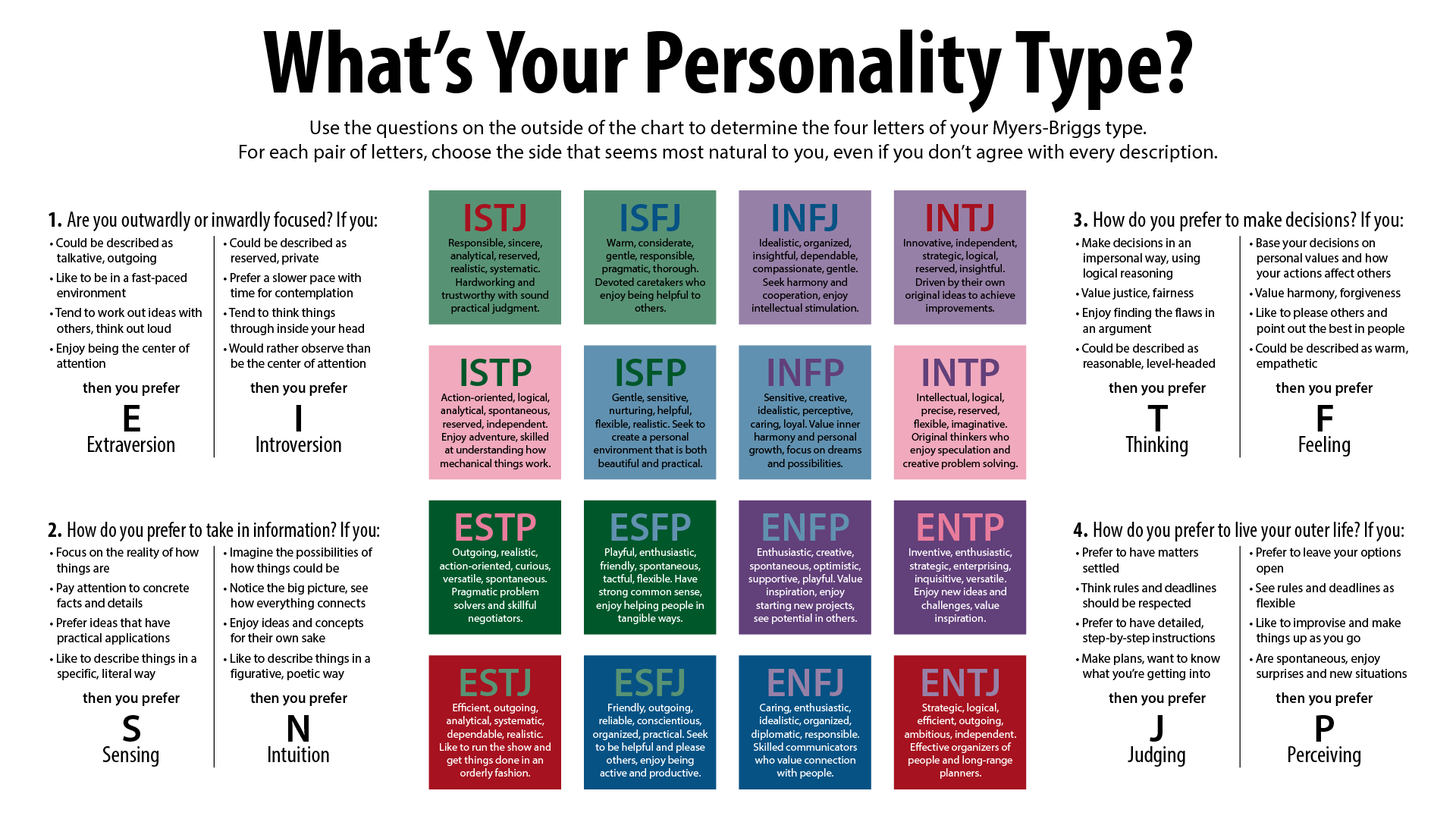
Spotlight on Myers-Briggs: Can A Textbook J Marry a Textbook P?

Although it's not Toras Moshe M'Sinai like some people seem to regard it, Myers-Briggs (M-B) typing is helpful in many ways. It helps us understand how we're all different, we each operate from different places and experience the world differently. Practically, this understanding regarding how something someone does is a part of his personality and not a lack of middos or a personal affront can help you to appreciate and get along with him better.

M-B relationship experts suggest that any two well developed individuals of any combination can get along with each other, and in fact, they say that J's compliment P's and vice versa, but strong J's and strong P's will have the hardest time getting along. An example would be in the P that balks at even being typed, boxed into a four letter identity, while the J loves that everyone can have a label.

Time, commitments, decisions, and just things in general are much more fluid for P's. A very strong P is the type that books travel in the Uber on the way to the airport, and his itinerary takes shape as he experiences his destination. The J has things planned out and booked months in advance with lists and reservations taken care of orderly and responsibly.

As a J, I used to think that P's were just irresponsible and couldn't get it together. For me, when I say something I mean it, and I try really hard to not back out of commitments, even if it's just a simple, "I have to go, I'll call you back." I need for words to be kept, for things be defined, and for ambiguity to be resolved.

I wouldn't say that I'm a hardcore J, as I am pretty easygoing about a lot of things. I frequently color outside the lines, agree with my imagination, and often laugh at the rules. I do enjoy some good spontaneity every now and again. However, I can say that I can keep up with the best of the J's that are exasperated by P's who seem to not know what's up and what's down.

There was this one guy who showed up for our dates, two in a row, without any plans. The first date he got a pass, because it was an unfamiliar city and all that, although I do expect a guy to have some sort of idea what do once he picks me up. The next date, which was the next evening, was even more perplexing to me. He had traveled in to date me; that was the only assignment. Somehow, he got distracted and decided to go snowboarding, because he had the day to himself. He lost track of time, got sidetracked or somesuch, and he arrived for our date a couple hours late, having not eaten since breakfast, with no idea what to do once I was in the car with him.

That type of P, though exciting and intriguing in other ways, just doesn't work for me. I personally can't get along with someone so all over the place. Although, I do think that I could do well with someone less J than I am, because he would chill me out a little if he didn't grate on my nerves. Opposites attract and all that.

Verdict?

Probably a strong P and a strong J would not get along easily, but as always, if both of the individuals worked on their understanding of personality differences and developed their personality traits, they could thrive in a relationship, each trait complimenting the disparate one in their spouse.

Wednesday, September 28, 2016

Science Says Mutual Vulnerability Leads to Love: Does Shidduch Dating Give Us an Edge?

There's been a lot of buzz regarding psychologist Aron's 36 Questions experiment, which explores how to foster interpersonal closeness between two strangers. He proposes that having two people share increasingly personal information with each other mirrors the manner in which two people develop emotional intimacy. 

The study involves a heterosexual man and woman meeting for the first time in a lab. They sit together answering a series of personal questions, and then they stare silently into each other’s eyes for four minutes. The result? Six months later, the two participants got married.

The study's author explains, "One key pattern associated with the development of a close relationship among peers is sustained, escalating, reciprocal, personal self-disclosure." In other words, vulnerability leads to closeness. By forcing people to be open and emotionally vulnerable with each other, this encourages closeness.

Mandy Len Catron writes an article for the NY Times, To Fall in Love With Anyone, Do This, in which she relates her personal experience with Aron's 36 Questions. She tells how an old college buddy says to her, “I suspect, given a few commonalities, you could fall in love with anyone. If so, how do you choose someone?” They decided to give The 36 Questions a shot. Catron shares that her personal experiment taught her that love doesn't just happen to us; it's more malleable than you might think. She says,
It’s true you can’t choose who loves you . . . and you can’t create romantic feelings based on convenience alone. Science tells us biology matters; our pheromones and hormones do a lot of work behind the scenes.
But despite all this, I’ve begun to think love is a more pliable thing than we make it out to be. Arthur Aron’s study taught me that it’s possible — simple, even — to generate trust and intimacy, the feelings love needs to thrive.
If all this is accurate, does the fast-paced, goal oriented style that we date engender vulnerability like Aron's Questions? Are these feelings "real," or are we just confusing this intensity with "liking" the person? Is this feeling sustainable when real life kicks in? Can you really love anyone as long as some basic prerequisites are present?

Perhaps the fact that shidduch dating is just more focused is what's at play here. Maybe removing a large aspect of physical compatibility from the equation while dating helps to foster more genuine emotional closeness quicker.

Trust, emotional intimacy, comfortability, are all important in a relationship, but there are a lot of other things that are important in a "forever" relationship too. Perhaps those conditions aren't so basic, but if met, then yes, being able to be vulnerable with someone can definitely lead to what we kids call love nowadays.

Monday, September 26, 2016

The "Click" Feeling (vs. "Love at First Sight")

Ah, the elusive "click."

What is this "click"? Can it be cultivated or must it be present from the beginning? Is it enough to build a relationship on? Do you need this feeling to tie the knot?

Awhile back I remember talking to someone about what they are seeking in a spouse/relationship. "Basically," they told me, "a good normal person, someone I 'click' with. That's it."

The romantic in me understands this (to a point), but the logical rational analytical side of me tells me that there is something beneath this"click" feeling. Especially when you're dating shidduch-style (and you must answer over and over again "what are you 'looking for'?") it may be important and helpful to figure out your "recipe."

Based upon my own relationships, friendships included, I can say there are definitely people I click with right away, and there are some that take a bit longer, but we can have just as meaningful and comfortable of a relationship. There are some people that I remember feeling like I wanted to be friends with right when I met them, while other friendships were brought about by shared experiences, perspectives, and circumstance.

The "click" feeling I'm referring to is not "love at first sight." Sorry to be a bubble-burster, but that does not exist in real life. That, folks, is what we call lust, often engendered by all the wrong reasons, and it falls apart.

Dutton and Aron's 1974 Love on a Suspension Bridge experiment  in which people were approached on a suspension bridge swaying 250 feet in the air, and they were given the phone number of the assistant that had approached them, showed that these people followed up with the assistants more than their counterpart who were approached on a solid wood bridge just 10 feet above a calm brook. These results were attributed to the fear arousal that the first group of people felt as they crossed the suspension bridge, the feeling that was misinterpreted as romantic excitement. This is a good example of "love at first sight," a false sense of excitement that can be attributed to various things, usually which have little to do with developing a healthy relationship.

To take this idea a bit further, recognize how fledgling love is selfish. Because real love, mature love, inherently comes from giving to the other person, love for someone when you first meet him/her is more of a "I love how you make me feel." This can be built upon, but it is in no ways the love that a good relationship thrives on.

While this "click" feeling is something that is often confused as "love at first sight," in reality it's a level of attraction that is based on various factors, and perhaps, ultimately, comes down to chemistry and maybe even pheromones. Therefore, as I understand it, it can only be analyzed to a point, but I'm going to give it a whirl.

The "click" appeal in a relationship has a lot to do with feelings of comfortability, similarity, mutual trust, and effortless communication. In other words, people feel like they "talk the same language," meaning s/he feels like the other just "gets" him/her. Contributing factors to this include shared backgrounds, experiences, and/or similar Weltanschauung.

Under duress of a well-meaning shadchan -- I was asked to explain why I didn't get along with/didn't like a particular guy I had gone out with a few times -- I set out to understand what didn't work between this guy and me and why. On paper things seemed perfect, but in person, despite that he was seeing rainbows and hearts, I was extremely bored and just didn't feel like we connected at all. After analyzing his personality, my personality, what we both think we need, and our interactions, I came to an understanding that he just didn't have a particular attribute that is essential for me in any meaningful relationship. Because of this, I believe, I just didn't like him. I couldn't connect with him. My dating experience has taught me that there are specific characteristics that work for me and some that just don't.

I think had I dated this guy sometime earlier on in my shidduch career, I probably would have gone out with him longer and given things more of a chance to blossom. Because I now have more insight into all this, because I understand my "recipe" a bit better, I have a more accurate idea of what has the potential to work and what does not. (That's not to say that I don't still give guys a chance even if we don't click right away. Hey, I might surprise myself; I'm always trying to stay positive and open here!)

I know that when I'm in a relationship (that's working for us), I feel a certain sense of safety and security, as well as there is no concept of time, meaning we can spend hours together and not get bored of each other. These aren't aspects per se that I look for in a relationship, but when they're there, this for me is part of our "click." Everyone's "click" feeling is something different. Essentially it's a feeling of mutual attraction, understanding, and ease in the relationship.

Not everyone has this "click" initially with their spouse. It can be developed as trust, understanding, and comfortability grow. Because a majority of these are based upon logical things like shared hashkafos, goals, values, communication, etc., there is often a natural progression, an easiness, if you will, that affects this.

I've found too that not everyone will have this contentedness or easiness in their relationship even after awhile, and their decision to marry their spouse will come from a more logical place. Things match up, they can check aspects off their list (more on lists a different time!), so to speak, and it just makes sense.

Please please keep in mind that sometimes the person you fall for/like right away can be for all the wrong reasons, and you must pay attention to the logical aspects of the relationships as well. "Click" is not love, it's an easiness and comfort. Even if it is "love," love does not conquer all! Passion fades and then you're left with the technicalities. If you don't have shared goals and values it doesn't matter how much you like your spouse. On the other hand, it's super important that you really like the person you marry, because things change, and when push comes to shove and you have to work conflicts out, you need to have a solid foundation to be building from.

"Click" is a chemistry that is often promoted by mutual understanding and shared outlook. It's an easiness that comes from understanding each other, and it can be present from the beginning of a relationship, or it can be nurtured. "Click" doesn't always exist, and alone it's probably not enough to seal the deal.

Wednesday, September 21, 2016

Do Looks Matter?

When it comes to looks, I'm pretty picky. I have fairly high standards for "handsome." That being said, I won't dump someone or not go out with him because he doesn't reach the bar. It's a given that you have to be physically attracted to the person that you marry. However, I'm a firm believer in if someone has a good personality, you like his internal, his looks have the potential to grow on you.

Perhaps this works for me because (I'd like to think that) I'm not superficial. I will usually give someone a chance even if his looks aren't what I would have picked. Because of that, unless there's a particular reason, I don't like seeing guys' pictures before a date. There's so much more to a person then just their physical outward appearance. I'd rather get to know someone as a person. With just the 2 dimensional image, I'm more likely to nix him before giving it a shot. I also remind myself that looks fade. The person inside is a lot more important, because that's the person you're stuck with even after he loses his hair and his metabolism slows down.

It's happened to me plenty of times, I've dated people who were, by no one's terms, "ugly," but I just really didn't care for their looks. With one guy in particular, we hit it off right away, and although his looks bothered me for awhile, I was able to look past it, and soon I thought he was really cute looking.

It's changed my outlook a little. Instead of being disappointed when meeting a blind date, I remind myself that if I end up liking the guy, I'll probably think he's cute after awhile.

Obviously if someone's looks bother you even after you get to know him, that's a different story. If you're not physically attracted to him, that's an issue. But, I do believe that external ends up reflecting internal.

Pageviews